The Central Bank of Paraguay delegates authorization powers to the Superintendency of Securities

Through Resolution No. 2, Minute No. 21, dated May 22, 2025 (the “Resolution”), the Board of Directors of the Central Bank of Paraguay resolved to delegate to the Superintendency of Securities (“SIV”) various powers related to the authorization and supervision of market participants in the securities sector.

Pursuant to the Resolution, the SIV is expressly authorized to grant operating licenses to issuers, external auditors, credit rating agencies, clearinghouses, securitization companies, bondholders’ representatives, commodity brokers, stock and trading desk operators, and investment advisors.

In addition, the SIV is granted the authority to approve the internal regulations of Stock and Commodity Exchanges, Central Securities Depositories, and Clearinghouses.

Formal requirements for Exchange Offices

Through Circular SB.SG. No. 84 dated May 27, 2025, the Superintendency of Banks (“SIB”) reminded exchange offices of their legal obligation to notify the opening or closure of branches, agencies, and auxiliary offices at least 30 days in advance, in accordance with Article 22 of Law No. 2794/05 “On Foreign Exchange Entities and/or Exchange Offices”.

In the case of openings, the notification must be accompanied by a sworn statement in which the entity expressly declares that it complies with all the requirements established by the applicable regulations.

Finally, the SIB warns that failure to comply with these provisions may result in the imposition of sanctions pursuant to the regime set forth in Chapter VIII of Law No. 489/95 “Organic Law of the Central Bank of Paraguay” as amended by Law No. 6104/18 “Which amends and expands Law No. 489/95”.

INFRASTRUCTURE | GOVERNMENT ANNOUNCES TENDER FOR THE CONSTRUCTION OF SAN ESTANISLAO GENERAL HOSPITAL – SAN PEDRO

The Ministry of Public Works and Communications (Ministerio de Obras Públicas y Comunicaciones or “MOPC”) has launched International Public Tender No. 09/2025 (ID 469514) for the design and construction of the new General Hospital of San Estanislao, in the department of San Pedro. This landmark project aims to improve healthcare access in the northern region of the country, benefiting populations in the departments of San Pedro, Concepción, Amambay, and Canindeyú.

Project Value and Financing

The project, financed by the Inter-American Development Bank (IDB), has an estimated value of USD 60 million, of which USD 30.25 million will be allocated to the design, construction, and maintenance of the infrastructure.

Offer Submission Deadline

Interested companies must submit their bids by August 4, 2025. The deadline for submitting inquiries is July 29, 2025. A site visit is scheduled for May 27. All dates are subject to change by the contracting authority (MOPC).

Project Details

The hospital will include:

  • 189 hospital beds: 157 for general hospitalization and 32 for intensive care.
  • Emergency services, operating rooms, gynecology and obstetrics, inpatient wards, intensive care, outpatient services with 31 consulting rooms, laboratories, diagnostic imaging, administrative areas, accommodation facilities, parking, green spaces, and a helipad.

The MOPC will oversee the bidding process, construction, and supervision, while the Ministry of Public Health and Social Welfare (Ministerio de Salud Pública y Bienestar Social or “MSPBS”) will be responsible for equipping the facility and strengthening healthcare services.

Execution and Contract

The contract will follow the 2017 FIDIC Yellow Book model, an international standard that places responsibility for both design and construction on the contractor. The projected timeline is 30 months (6 for design and 24 for construction), followed by an additional 18 months of maintenance after provisional handover.

****

For further information, please contact: Rodolfo G. Vouga (rgvouga@vouga.com.py); Manuel Acevedo (macevedo@vouga.com.py); Silvia Benítez (sbenitez@vouga.com.py); Lucas Rolón (lrolon@vouga.com.py); Yvo Salum (ysalum@vouga.com.py).  

Brokerage Firms to become Direct Participants in LBTR and DEPO/X

Through Resolution No. 12, Minutes No. 15, dated April 10, 2025, the Board of the Central Bank of Paraguay (“BCP”) resolved that brokerage firms will become Direct Participants in the Real-Time Gross Settlement System (LBTR) and the Securities Depository System (DEPO/X), effective as of March 31, 2027.

Currently, brokerage firms operate as Indirect Participants in the Paraguayan Payment System (SIPAP) through services provided by third parties. However, with this change, they will be directly integrated into the LBTR and DEPO/X systems.

In this regard, the BCP will establish the implementation schedule to ensure an orderly transition in accordance with the technical and operational requirements to be defined. Until the effective date, brokerage firms will continue to operate as Indirect Participants.

The Central Bank of Paraguay establishes new limits on card use fees

Through Resolution No. 7, Minute No. 11, dated March 13, 2025 (the "Resolution"), the Central Bank of Paraguay established new caps on the fees applied for payment intermediation services made through credit or debit cards. This measure aims to align the Paraguayan market with international practices and promote financial inclusion.

According to the Resolution, the new limits will be applied gradually:

  1. From July 1, 2025, the maximum fee will be 4% for credit cards and 3% for debit cards.
  2. As of July 1, 2026, these caps will be reduced to 3% for credit cards and 2% for debit cards.

The decision is based on a technical analysis that identified current rates as being above regional standards. The reduction in commissions seeks to benefit businesses, especially small ones, by allowing them to access to electronic payment methods at lower costs, which could translate into more competitive prices for consumers.

The Central Bank of Paraguay establishes mew rules for charging fees on card transactions

Through Resolution No. 6, Minute No. 11, dated March 13, 2025, the Central Bank of Paraguay (“BCP”) introduced amendments to Article 20 of Resolution No. 43, Minutes No. 95, dated December 30, 2015, which regulates the collection of intermediation fees on debit and credit card transactions.

With this modification, issuing entities and/or operators must publish all intermediation fees applied to affiliated merchants on their websites, distinguishing between debit and credit card transactions. This information must be presented in a matrix that categorizes transaction amounts and average payment receipt values (tickets) and will be distinguished by type of card, whether debit or credit. Additionally, entities are required to continuously update the information on the fees charged, ensuring that merchants and the public have access to up-to-date and accurate data.

Furthermore, BCP will establish the maximum rate applicable to intermediation fees. It is clarified that this maximum rate encompasses the total sum of all intermediation fees charged during the payment process, regardless of the functions or means used by the entities involved. However, additional fees may be applied for services other than electronic payment intermediation, such as business management, fund flow administration, or data analysis, provided that acquiring these services is not mandatory to access intermediation services.

Issuing entities and/or operators must submit their fee policies applicable to affiliated merchants to the central bank within the first half of January each year. These policies must include at a minimum: (i) a technical justification for the applied fees or reasons for modification; (ii) a technical study supporting any variations; (iii) a description of the services provided; and (iv) a breakdown of fixed and variable costs, specifying the calculation methodology and the distribution of costs among fees, operators, and merchants within their respective networks.

Authorization for the purchase, holding and sale of debt securities by Banks and Financial Institutions

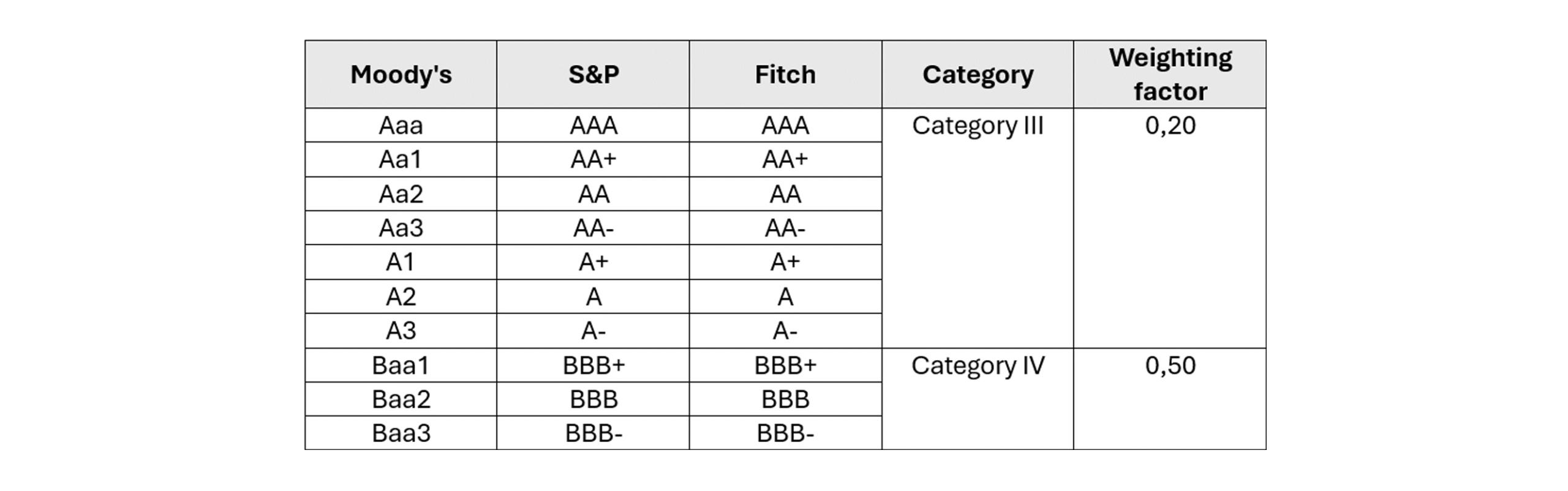
Through Resolution No. 3, Minute No. 16, dated April 15, 2025, the Board of Directors of the Central Bank of Paraguay ("BCP") authorized banking and financial institutions to purchase, hold and sell debt securities in foreign currency, issued by national governments and foreign financial institutions, provided such securities have an investment-grade credit rating granted by at least two of the following rating agencies: Fitch Ratings, Moody's or Standard & Poor's.

The regulation sets a global limit of up to 20% of each institution’s effective equity for holding these financial instruments. Furthermore, it establishes that, for the purpose of calculating capital adequacy indicators, investments in these instruments must be classified according to the risk rating of the issuing country, based on the weighting table defined in the same resolution:

Amendments to the Securities Market Regulation

Through Resolution No. 2, Minute No. 16, dated April 15, 2025, the Board of Directors of the Central Bank of Paraguay (BCP) amended various provisions of the General Securities Market Regulations (the "Regulation").

First, Chapter 2 of Title 26 "Depositors" of the Regulation, along with its Annexes A and B, was derogated. Article 9 of Chapter 12, Title 13 "Brokerage Houses" was also derogated.

Amendments were made to the definitions set forth in Article 1 of Title 26. The redefined terms include: (i) Depositors; (ii) Institution in charge of book-entry registration; (iii) Principal; (iv) Book-entry; and (v) Titles. The new definitions adopt more concise language and eliminate specific references to authorizations granted by the National Securities Commission.

Furthermore, Article 3 of Chapter 4, Title 3 “Brokerage Firms” was updated to define the securities admissible for over-the-counter transactions involving brokerage firms, both domestically and abroad. Among the most significant changes is the exclusion of Negotiable Custody Certificates (CCNs) from the list of securities admissible locally, while internationally, the previously established eligibility criteria were maintained.

INFRASTRUCTURE | GOVERNMENT ANNOUNCES FIRST RAPID ACCESS AND EXIT SYSTEM FOR GRAN ASUNCION

On April 7, 2025, the Ministry of Public Works and Communications (Ministerio de Obras Públicas y Comunicaciones or “MOPC”) announced an ambitious road improvement project to connect the cities of Luque, Areguá, and San Bernardino with Route PY 02 (“Project”). With an estimated investment of USD 180 million, the Project will become the first rapid access and exit system aimed at optimizing mobility between the metropolitan area of Asunción, enhancing connectivity with the departments of Central and Cordillera.

Strategic Sections

The Project will be divided into three main sections:

  • Ypacaraí – Areguá – Luque Corridor: starting at Km 41 of Route PY 02, it passes through Ypacaraí, Patiño, and Areguá, reaching downtown Luque. It includes a new bypass in Areguá to optimize traffic flow.
  • Ypacaraí – San Bernardino – Luque (Tarumandy) Corridor: starting at Km 43, it connects San Bernardino with Luque. It includes lane duplication at the entrance to San Bernardino, urban improvements in the city, and lane expansions along the “Ecovía” section.
  • Elevated Expressway: a 4 km elevated stretch with 2 roadways and 4 lanes, connecting Luque’s urban area to the Conmebol area. This expressway will be compatible with the future commuter train and will preserve Luque’s urban dynamic.

Contractual Framework and Financing

The Project will be carried out under the addendum to the Public-Private Partnership (PPP) contract for the construction/expansion, operation, and maintenance of Route PY 02 (the “Works”), executed between the Paraguayan State and the Rutas del Este consortium (Sacyr and Ocho A), which was awarded the Works for a 30-year term. The addendum does not extend this term, so the Project must be executed within the remaining time of the original contract. Additionally, the addendum does not imply a direct award of the Project to the Rutas del Este consortium. The MOPC will launch a public tender process to award the execution of the Project. The selected company must secure 100% of the Project’s financing. However, the addendum grants the Rutas del Este consortium the right to match the best offer submitted by any bidder. Should it choose to exercise this right, Rutas del Este will be awarded the Project.

The tender is expected to be launched at the end of July, with the contract signing scheduled for August 2025. Construction is expected to begin by the end of 2025, with a projected execution period of three years.

The Works were carried out under Law No. 5102/13 on Public-Private Partnerships (PPP), which was recently repealed by Law No. 7452/25.

Repayment Structure

The investment repayment will be structured through three mechanisms:

  • Deferred Payments: semiannual payments over a 15-year period, beginning the month after 36 months from the issuance of the first notice to commence works.
  • Availability Payments: quarterly payments starting from the provisional commissioning of each section and continuing until the end of the contract.
  • Traffic-Linked Payments: variable payments tied to traffic volume in the covered sections, payable after the final provisional commissioning.

Impact

The project will benefit approximately 1.3 million people who travel daily through the metropolitan area of Asunción, reducing travel time by up to 30 minutes per trip in each section. This initiative marks a milestone in the modernization of Paraguay’s road infrastructure and opens new opportunities for private sector participation in PPP projects.

For further information, please contact: Rodolfo G. Vouga (rgvouga@vouga.com.py); Manuel Acevedo (macevedo@vouga.com.py); Silvia Benítez (sbenitez@vouga.com.py); Lucas Rolón (lrolon@vouga.com.py); Yvo Salum (ysalum@vouga.com.py).  

Regulación Energética en el Paraguay – Parte I: Marco legal y perspectivas

Esta publicación inaugura una serie de entregas sobre el marco regulatorio del sector energético en Paraguay. En esta primera parte, exploramos en detalle la legislación vigente, el rol de las instituciones clave y los elementos que marcan el rumbo del desarrollo energético nacional. Un material útil tanto para quienes operan en el sector como para quienes analizan oportunidades de inversión en energías renovables.

🔜 En la próxima entrega: un análisis práctico de los procedimientos de licenciamiento, los modelos contractuales vigentes y las principales barreras que enfrentan los desarrolladores de proyectos energéticos en Paraguay.

Para obtener más información respecto de alguno de los temas abordados en esta primera entregar, por favor póngase en contacto con nuestros expertos: Manuel Acevedo (macevedo@vouga.com.py); Rodolfo Vouga Z. (rgvouga@vouga.com.py); Yvo Salum (ysalum@vouga.com.py