
Executive Summary
| Event | Date | Content |
| Infrastructure | Public Tender | N/A | The Ministry of Public Works and Communications (MOPC) announced the confirmation of the construction of the Southwest Corridor, which will connect the departments of Ñeembucú and Misiones. |
| Renewable Energy Law | December 11, 2025 | The Executive Branch enacted Law No. 7599/25, “On the Modernization of the Regime Regulating and Promoting Electric Power Generation from Non-Conventional, Non-Hydraulic Renewable Energy Sources.” |
| Infrastructure | Road Corridor | December 16, 2025 | The Ministry of Public Works and Communications (MOPC) announced the complete renovation of Gervasio Artigas Avenue. |
| Mobility | Transport Law | January 7, 2026 | The Executive Branch enacted Law No. 7617/26, “Establishing the Governing Authority for Land Transport and Modifying and Expanding the Provisions of Law No. 1590/00.” |
| Energy | New Consumption Groups | January 16, 2026 | The Executive Branch enacted Decrees No. 5306/26, “Adopting the Establishment and Development of Convergent Industries as a Sectoral Public Policy, Creating the Bi-Ministerial Commission for the Accreditation of Convergent Industries and the Convergent Industries Consumption Group, Establishing Applicable Electricity Tariffs, and Repealing Decrees No. 7551/2017, No. 6371/2016, and No. 7406/2011”; and No. 5307/26, “Including 'Power to X' initiatives within the Sectoral Public Policy for Convergent Industries established in Decree No. 5306 of January 16, 2026, Creating the Consumption Group for 'Power to X' Industries — including energy vectors and raw materials produced with energy — and Establishing the Applicable Electricity Tariffs.” |
| Public Procurement | January 22, 2026 | The National Directorate of Public Procurement issued Resolution No. 195/2025, “Establishing maximum deadlines for the communication of tenders, awards, and contracts affecting procedures involving the 2026 General Budget (PGN 2026).” |
More Information:
- Infrastructure | Public Tender for the Construction of the Southwest Corridor
The Ministry of Public Works and Communications (MOPC) announced the confirmation of the construction of the Southwest Corridor (the “Project”), which will connect the departments of Misiones and Ñeembucú. The scope of the Project includes the following works:
- Construction of 154 km of new roads;
- 25 km of urban crossings;
- Asphalt paving of departmental roads No. 77 and 79;
- Intervention of 111 km of National Route PY 20; and,
- Improvements to the access road to the town of Cerrito.
The Project will connect the towns of Yabebyry, Laureles, Cerrito, Villalbín, Mayor Martínez, and Pilar.
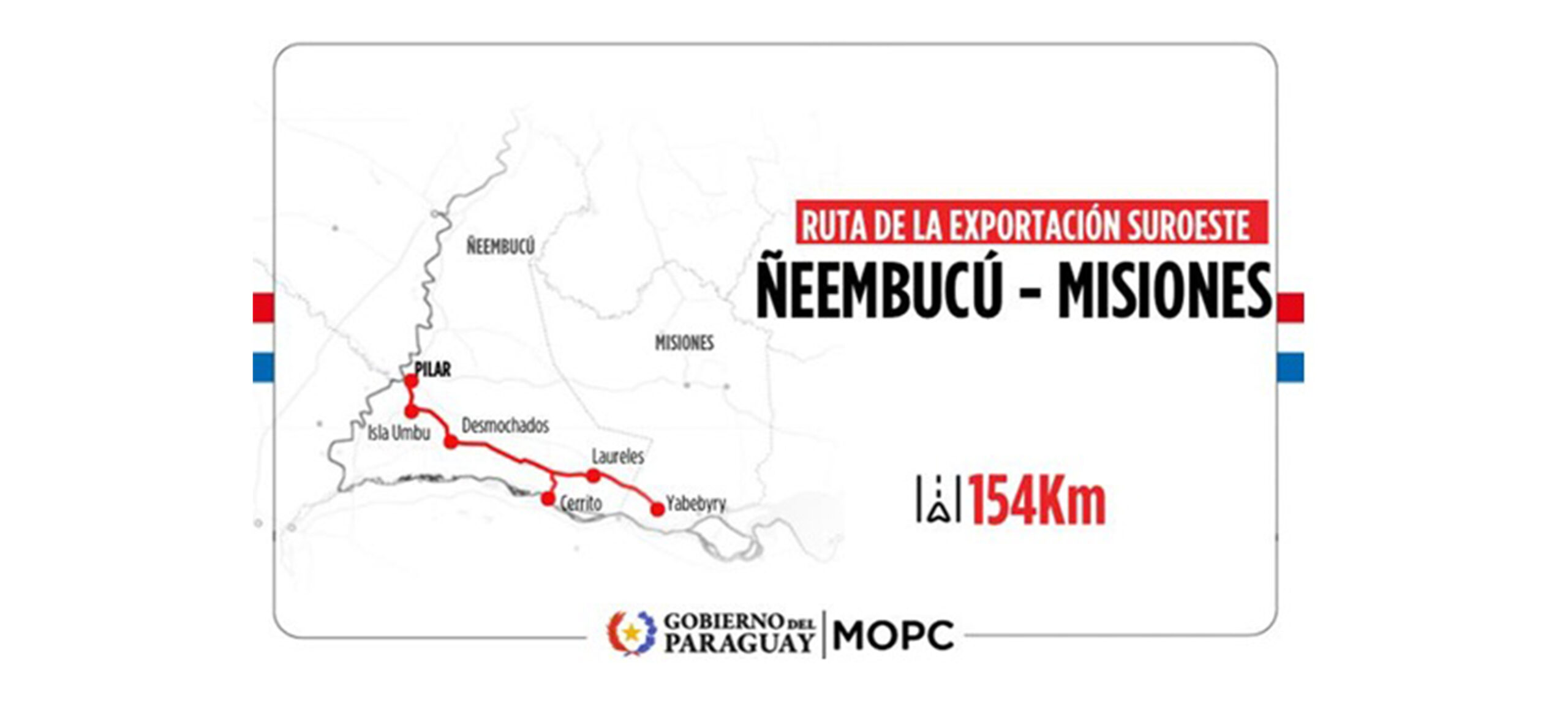
The estimated value of the Project is Gs. 2.270.700.000.000 (USD 300.000.000), of which USD 243 million will be financed by the Japan International Cooperation Agency (JICA) and USD 60 million by the Paraguayan State. The loan is currently pending approval by the National Congress.
To date, the regulatory framework under which the project will be tendered has not been confirmed. However, MOPC authorities have reported that the tender is expected to be published in 2026.
For more information regarding the Project, please click on the following here.
- Renewable Energy | Enactment of Law No. 7599/25 on Electric Power Generation from Non-Conventional, Non-Hydraulic Renewable Energy Sources
On December 11, the Executive Branch enacted Law No. 7599/2025, “On the Modernization of the Regime Regulating and Promoting Electric Power Generation from Non-Conventional, Non-Hydraulic Renewable Energy Sources” (“Law 7599”).
This Law repealed Law No. 6977/2023, which previously regulated the generation and commercialization of non-conventional, non-hydraulic renewable energy. Law 7599 introduces significant amendments to the energy legal framework. Among the most relevant, we highlight:
- Tariff Law 7599 establishes that the “NCRE Reference Tariff” will be set annually by the enforcement authority1 following a technical report from ANDE, which must consider precedents, relevant data, and any other available information. Thus, Law 7599 replaces the criteria of Law 6977/23, which calculated the NCRE Reference Tariff based on the average generation cost.
- Direct Sales Between Private Parties: La Ley 7599 establece por primera vez la posibilidad de que Cogeneradores y Autogeneradores puedan vender sus excedentes de producción a privados mediante la incorporación de la figura del “Gran Consumidor”. El Gran Consumir es aquel que tenga una demanda ≥ a 30 MW.
- Type of Generation: The distinction between interruptible and non-interruptible generation sources is suppressed, thereby eliminating any differentiation in the application of the NCRE Reference Tariff based on the type of generation.
- Extension of License and Contract Terms: The validity of licenses and contracts is extended from 15 to 30 years, strengthening regulatory predictability and project bankability.
- New Trust: A management trust is created to administer the resources designated for payments to Generators.
- Tax Incentives: Licensees are granted access to the incentives provided under Law No. 523/1995 on Free Trade Zones, a benefit not previously included in Law 6977.
For the effective implementation of Law 7599, the enactment of its regulatory decree is still required to establish the operational and procedural aspects of the regime. The decree is expected to be enacted during the first quarter of 2026.
To access the full text of Law 7599, please click on the following here.
- Infrastructure | Renovation of Gervasio Artigas Avenue
On December 16, 2025, the Ministry of Public Works and Communications (MOPC) announced the project for the complete renovation of Gervasio Artigas Avenue, one of Asunción’s main urban arteries. The MOPC indicated that the project has been submitted to the Ministry of Economy and Finance (MEF) for the corresponding authorizations.
The main aspects of the project include:
- Estimated Start and Completion Dates: Project execution is expected to begin in late 2026 and reach completion by mid-2028.
- Legal Framework: Law No. 5074/13 “Turnkey”.
- Financing: To be provided by the awarded contractor.
- Project Value: USD 35 million.
- Scope of Works: Full renovation of the rigid pavement, undergrounding of low and medium voltage grids and telecommunications lines, drainage works and bridges, new traffic signaling, modern lighting, and landscaping with native species.
- Status The tender is scheduled to be launched during the first quarter of 2026, with the award estimated for June or July.
For more information regarding this project, please click on the following here.
- Mobility | Enactment of the Public Transport Reform Law
On January 7, 2026, the Executive Branch enacted Law No. 7617/26, “Establishing the Governing Authority for Land Transport and Modifying and Expanding the Provisions of Law No. 1590/00” (“Law 7617”).
Among the main updates introduced by Law 7617, we highlight the following:
- Operational Structure
- The MOPC will grant concessions for the provision of Metropolitan Public Transport Services through public tenders.
- Metropolitan public transport services must include: (i) fleet provision contracts, (ii) infrastructure provision contracts, (iii) operation within functional units, and (iv) complementary services necessary for operation.
- The MOPC is authorized to tender these services either separately or jointly. Fleet provision, fleet operation, and complementary service contracts will be granted for terms of up to 15 years; infrastructure provision contracts will be granted for terms of up to 20 years.
- For the resolution of disputes between the concessionaire and the contracting authority, the parties may agree to arbitration.
- Revenues
- The user fare will be established by the Paraguayan Executive Branch, based on a proposal from the MOPC.
- Remuneration may combine different factors, such as the number of passengers transported, mileage covered, fleet size, yard area and services, technology availability, service levels, and performance indicators (e.g., scheduled frequency, regularity).
- Remuneration to providers will be adjusted according to polynomial price variation indices, which will be defined in the bidding terms and conditions.
- Guarantees | Financing and Cash Flow
- A Management Trust for the Financing of the Public Passenger Transport Service is created, with the Financial Development Agency acting as the trustee and the MOPC as the trustor.
- To guarantee the sustainability of the trust, the MOPC, in coordination with the MEF, must provide coverage for firm liabilities for a minimum period of 12 months.
- Revenue from ticket sales will be transferred daily to the trust, which will pay the providers according to the instructions issued by the MOPC.
- The administration, distribution, management, and execution of the trust's financial resources will be subject to oversight.
- Other Provisions
- The State, within the framework of public bidding processes, may acquire bus fleets and infrastructure intended for metropolitan public passenger transport services. These assets may be put into service through leasing, bailment, usufruct, fiduciary mandates or management trusts, financial leasing, etc. In the case of buses featuring new technologies (such as electric or hybrid vehicles), direct agreements for pilot tests may be signed for limited periods.
- A special regime is created for assets intended for public transport services, including a registry and rules for their decommissioning. These assets enjoy special protections: (i) assets assigned to the service are exempt from judicial pursuit by the provider's creditors, except for the financier of said assets; and (ii) in the event of a foreclosure by the financier, the assets will remain operational, and the same remuneration mechanisms received by the original provider will apply.
- Failure to comply with payment obligations will result in the issuance of debt certificates by the MOPC, which shall be considered enforceable titles.
The full text of Law 7617 is available by clicking on the following here.
- Energy | Creation of New Consumption Groups for Convergent Industries
On January 16, 2026, the Executive Branch enacted Decrees Nº 5306/2026 and Nº 5307/2026, introducing a new public policy framework aimed at fostering the establishment and development of energy-, technology-, and innovation-intensive industries in Paraguay.
Decree No. 5306/2026 (“Decree 5306”) establishes the development of so-called Convergent Industries as a sectoral public policy. This concept encompasses high-tech productive activities that use stable and renewable electricity as a critical input for value creation, including High-Performance Computing (HPC) infrastructure, Artificial Intelligence, cloud services, advanced manufacturing processes, and other energy-intensive industrial transformations. Decree 5306 creates a new electricity consumption group for these industries, applicable to various voltage levels (500, 220, 66, and 23 kV), with tariffs denominated in U.S. dollars and a horizon of up to 15 years, subject to update mechanisms.
As part of the same scheme, Decree 5306 creates a Bi-Ministerial Commission composed of the Ministry of Industry and Commerce and the Ministry of Information and Communication Technologies. This commission will be responsible for accrediting companies that qualify as Convergent Industries based on the submission of a “Productive Linkage Plan” aimed at maximizing local economic and technological impact.
Decree No. 5307/2026 (“Decree 5307”) complements Decree 5306 by introducing specific treatment for Convergent Industries categorized as “Power-to-X.” These include projects that convert renewable energy into energy vectors and raw materials such as hydrogen, ammonia, methanol, synthetic fuels, and others. Decree 5307 formally incorporates these ventures into the Convergent Industries regime and creates a differentiated consumption group for these projects, provided they operate in Very High Voltage (220 kV). Similar to Decree 5306, Power-to-X projects will also be subject to U.S. dollar-denominated tariffs with a projected duration of up to 15 years. Unlike the general regime, the Ministry of Industry and Commerce acts here as the sole enforcement authority for the accreditation and authorization of these projects.
Both decrees align with the objectives of the Paraguay 2050 National Development Plan and an investment attraction strategy based on leveraging the country's comparative energy advantage, promoting higher value-added activities, know-how transfer, and integration into global productive chains.
From a practical perspective, the framework is still in its initial implementation phase. The adjustment of the tariff structure by ANDE and compliance with the administrative deadlines set forth in the decrees will be necessary steps. However, the full operability of the new regimes will depend on complementary regulations and the materialization of specific projects — processes that will reasonably take time.
Nonetheless, Decrees 5306 and 5307 represent a clear policy signal toward industrial and energy development in high-value projects. While significant challenges remain regarding implementation and institutional coordination, they constitute a positive step in strengthening Paraguay's attractiveness as an investment destination in key sectors such as energy, technology, and high-tech industries.
- Maximum Deadlines for Notifying the National Directorate of Public Procurement of Procedures Involving the 2026 General National Budget
On January 22, 2026, the National Directorate of Public Procurement (NDPP) issued Resolution No. 195/2025which mandates that procuring entities must notify all procedures that partially or fully involve the budget for the 2026 fiscal year, regardless of the source of financing.
In particular, the resolution establishes that tenders, awards, contracts, their corresponding amendments, and any procedures subsequent to the issuance of the procurement code must be reported to the NDPP in accordance with the deadlines established in the Annex of the Resolution.
The NDPP will not issue procurement codes nor disseminate files through the Public Procurement Information System that do not comply with the deadlines established in this Resolution.
Other news:
- Suspension and Cancellation of Relevant Tenders
The National Directorate of Public Procurement declared the suspension and the cancellation of the following tenders, respectively:
- International Public Tender ID No. 459961 for the design and construction of drinking water and sanitation works in the Mariano Roque Alonso basin (approximately USD 142.000.000).
- International Public Tender ID No. 470438 for the design and execution of the hydro-electromechanical rehabilitation and modernization of the Acaray-Yguazú Hydroelectric Complex (approximately USD 82.000.000).
For further information regarding any of the topics covered in this edition of our newsletter, please contact: Rodolfo G. Vougargvouga@vouga.com.py); Manuel Acevedo (macevedo@vouga.com.py); Silvia Benítez (sbenitez@vouga.com.py); Lucas Rolón (lrolon@vouga.com.py); Yvo Salum (ysalum@vouga.com.py).
1. The MOPC, through the Vice-Ministry of Mines and Energy (Art. 7 of Law 7599).